
Perseverance Rover Discovers Ancient River Delta on Mars
NASA's Perseverance rover has detected a hidden, ancient river delta beneath Jezero Crater, suggesting long-lasting aqueous conditions on Mars. This finding may provide insights into past microbial life.
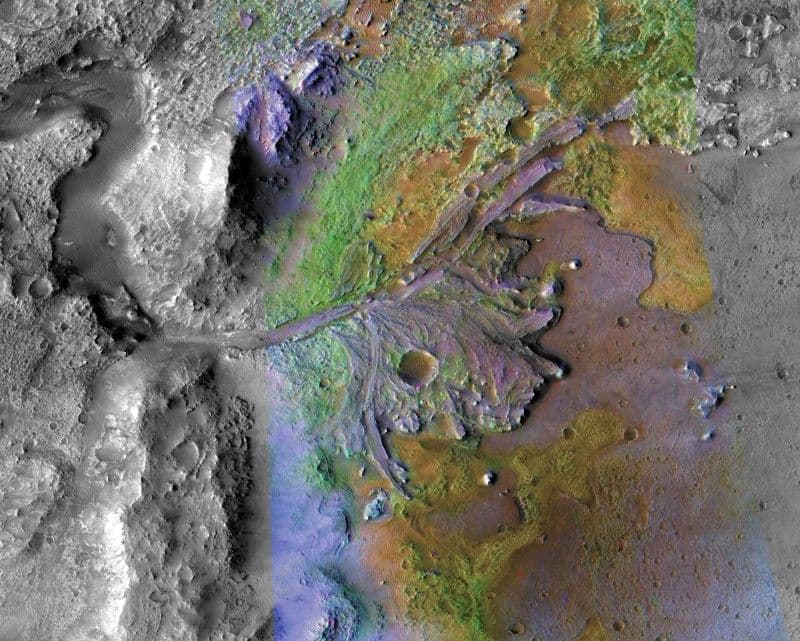
NASA’s Perseverance rover, which landed in Jezero Crater in 2021, was tasked with investigating the remnants of a dried-up lakebed for evidence of ancient life. Researchers have been particularly interested in the crater’s Western Delta, a geologic feature formed by a river that flowed into the basin billions of years ago. Recently, however, Perseverance’s ground-penetrating radar, known as RIMFAX, has identified what is likely an even older river delta buried beneath the surface.
Emily L. Cardarelli, an astrobiologist from the University of California, Los Angeles, who led the team analyzing the RIMFAX data, noted, “I think it’s a promising place to look for signs of biosignatures at depth.” She explained that microbial life could have potentially thrived in such environments.
The RIMFAX, or Radar Imager for Mars Subsurface Experiment, continuously sends radar waves into the Martian ground and records data each time the rover moves 10 centimeters. These waves bounce back when they encounter different rock, ice, or sediment layers, allowing scientists to create vertical cross-sections of the Martian crust, akin to a sonogram.
From September 2023 to February 2024, spanning over 250 Martian sols, Perseverance traversed a geological area known as the Margin unit. This unit, located along the inner rim of Jezero’s inlet valley, lies between the western fan deposits and the crater rim. Its rich magnesium carbonate content is one reason Jezero Crater was chosen as the rover's landing site, as carbonates are adept at preserving chemical signatures of life. Cardarelli likened it to the fossil-rich Cliffs of Dover on Earth.
Analysis of the RIMFAX data revealed that the Margin unit's rock was particularly transparent to radar waves, allowing deeper penetration than any previous explored regions within Jezero. The radar successfully probed depths exceeding 35 meters, about 1.75 times deeper than measurements from the crater floor or the overlying Delta units. Taking surface topography into account, researchers estimate that the Margin unit is at least 85 to 90 meters thick.
The radar's findings showed a complex arrangement of geological features beneath the Margin unit. Similar to the layered structures seen in Earth’s river deltas, the RIMFAX data revealed distinct sedimentary layers that indicate historical water flow, sediment deposition, and shifting water levels.
The radar images presented parallel layers inclined towards the center of the Jezero basin, displaying classic features known as clinoforms—sedimentary layers that extend into the water as rivers deposit material. The radar captures transitions within the sediment layers, suggesting a dynamic fluvial environment with multiple episodes of sediment deposition over an extended period.
This subsurface structure alters the understanding of Jezero Crater's watery history. The RIMFAX data indicates that the Margin unit lies beneath the Western Delta rocks, suggesting that the underlying sediments are older. If Cardarelli's interpretation holds, it implies that an ancient river system had previously created a substantial delta in the same area during the Noachian period, around 4.2 to 3.7 billion years ago, when Mars was warmer and wetter.
Despite the compelling nature of this discovery, Cardarelli’s team acknowledges that the ancient river delta hypothesis is one of several possibilities that could explain the RIMFAX data. Other theories include the idea that the detected geological features could result from igneous processes, such as volcanic activity, or represent remnants of a shoreline from an ancient lake.
Cardarelli emphasized the significance of the fluvial hypothesis, as it is most conducive to the existence of past Martian life. A large delta system feeding into a crater lake would provide the necessary nutrients, water, and energy for stable aquatic environments, which are essential for life. “We know that there are potential signs of past microbial life at the surface of Jezero Crater,” Cardarelli said. “Now we see there was an aqueous history there for quite a long time.” She believes that further exploration of Jezero Crater will yield more insights.
The findings presented were based on 6.1 kilometers of Perseverance’s traverse, with additional data covering 40 kilometers still to be analyzed. “We have more to say about this area. There are many stories yet to be uncovered,” Cardarelli noted.